

Highway ReconstructionSlope StabilizationNPDES Compliance
MnDOT I-494 Corridor Reconstruction
High-Performance Slope Stabilization Through Active Traffic and Sensitive Terrain
Service · Quality · Integrity
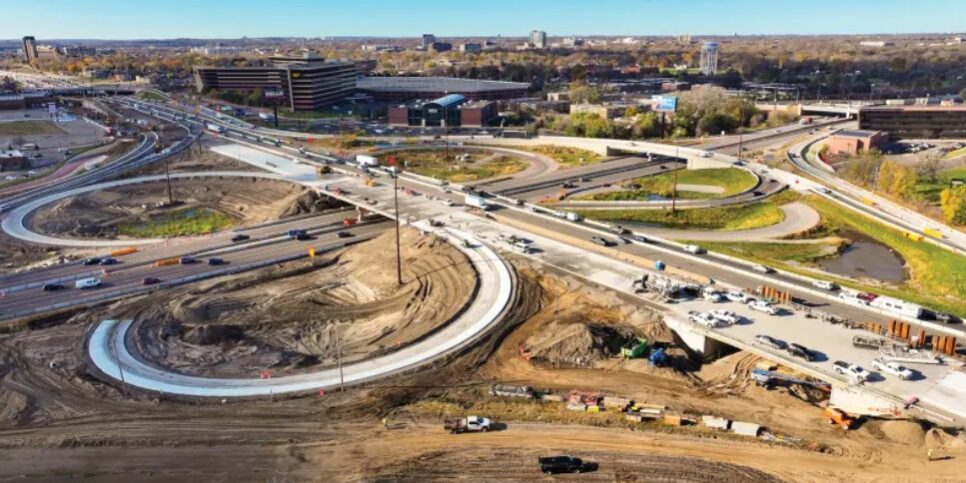
Reconstruction along the MnDOT I-494 corridor demanded an erosion control system that could install quickly, hold aggressively, and protect newly seeded slopes without failure — all while active freeway traffic kept rolling just feet away.
Between Richfield and Bloomington, Minnesota, crews reshaped interchanges, rebuilt embankments, and stabilized steep slopes adjacent to wetlands, residential neighborhoods, and high-volume traffic lanes. With limited work windows, aggressive grading schedules, and soils exposed to stormwater and seasonal freeze-thaw cycles, the margin for error was effectively zero.
2:1
Steepest slope grade on the project
10–14
Days to seed germination after blanket install
0
Blanket failures recorded across the project
12 mo
Functional lifespan — fully biodegradable
The Challenge
A Live Freeway. Sensitive Wetlands. No Room for Failure.
Grading operations exposed compacted clay loam and urban fill soils across long stretches of embankment, with slopes commonly reaching 3:1 and tightening to 2:1 in select locations. These soils retained moisture during extended wet periods yet shed runoff rapidly during intense summer storms — a combination that created high risk of surface erosion, rilling, and sediment transport into nearby water resources.
Passing traffic generated constant wind shear along active lanes, while roadway splash-over introduced additional hydraulic stress along shoulders and slopes. Construction sequencing left little margin for corrective measures: staging areas were constrained by barriers, pavement edges, and adjacent wetlands, and traffic remained active throughout the entire project duration.
Compliance with Minnesota Pollution Control Agency NPDES requirements strictly prohibited sediment migration into nearby water resources, placing immediate and unrelenting pressure on erosion control systems to perform from the first moment of installation — with no grace period and no room for a second attempt.
The Solution
An Erosion Control Blanket Engineered for the Worst Case
To address these conditions, the project team selected the Ero-Guard EG-2X-NN erosion control blanket for slope stabilization and turf establishment. Designed specifically for high-stress applications, EG-2X-NN combines curled excelsior fibers with double jute netting, creating a dense, interlocked matrix engineered to resist displacement under runoff, wind, and traffic-induced forces simultaneously.
Listed under MnDOT Category 25 for turf establishment and slope protection, the blanket met state specification requirements from day one — a critical threshold on a DOT project where non-listed products are simply not an option. Its twelve-month functional lifespan provided the durability required across a full construction season while remaining fully biodegradable, making it compatible with installation near wetlands and sensitive areas where long-term environmental performance mattered as much as immediate protection.
Product Spotlight — Ero-Guard EG-2X-NN
Curled excelsior fibers + double jute netting
MnDOT Category 25 — Turf Establishment & Slope Protection
12 months — fully biodegradable
Steep slopes, live traffic, wetland-adjacent sites
Installation
Precision Under Pressure — Installing on a Live Freeway
Installation progressed under active freeway conditions, requiring precision and efficiency at every stage. The sequence was deliberate and tightly controlled to maximize protection from the moment slopes were exposed.
Subgrade Preparation
Crews fine-graded slopes to remove protruding rocks and debris, creating a clean, consistent surface for blanket-to-soil contact. MnDOT-approved seed mixes were applied immediately prior to blanket placement to prevent surface crusting and maximize germination timing.
Blanket Placement & Anchoring
Rolls were unrolled downslope with a six-inch anchor trench securing the top edge against surface runoff undermining. Overlaps of four to six inches ensured continuous coverage with no exposed gaps. U-staples were installed in dense patterns, with increased density near pavement edges, culverts, and other high-exposure zones.
Traffic & Wind Management
Temporary wind barriers were deployed during installation to counteract vehicle-induced gusts from adjacent live lanes. Daily inspections allowed crews to identify and address minor blanket shifts caused by traffic, dust, or weather events before they could escalate into performance issues or compliance concerns.
The double-netted configuration provided a level of soil grip that standard Type 2 blankets could not match — particularly on steep slopes adjacent to live traffic.
— Field Crew Observation, I-494 Corridor Project
The Results
Zero Failures. Full Vegetation. Season Closed in Compliance.
Early summer storms tested the system almost immediately after installation, delivering heavy rainfall across freshly graded slopes. EG-2X-NN held firmly in place across every section — no rill formation, no sediment movement, no blanket failures, even on the steepest 2:1 grades exposed to both freeway runoff and vehicle wind shear.
Slope Integrity
No blanket failures recorded across any section of the project — including the steepest 2:1 grades exposed to freeway runoff, wind shear, and heavy summer rainfall simultaneously.
Rapid Vegetation
Seed germination occurred within 10 to 14 days of installation. Uniform vegetative cover was established by August, with the excelsior fiber matrix retaining critical soil moisture beneath the blanket during dry periods.
NPDES Compliance
Regulatory requirements were met without interruption throughout the construction season. No sediment migration into adjacent wetlands or water resources was recorded, and no corrective work orders were issued.
Season Close-Out
As fall rains arrived, slopes remained stable and fully vegetated. The project closed out the season with compliance intact, no rework required, and no delays attributed to erosion control performance.
Field Best Practices
What the Crew Learned — and What It Means for Your Next Project
Field teams on the I-494 project identified installation practices that further optimized EG-2X-NN performance under freeway conditions. These observations are directly applicable to similar highway, interchange, and embankment projects.
Staple Density at Edges
Increase staple density near pavement edges where vehicle-induced wind is strongest. Standard density patterns developed for non-freeway applications are insufficient in high-shear zones.
Seed Before You Roll
Coordinate seeding immediately ahead of blanket placement — not hours before. Delay between seeding and blanket installation allows surface crusting that inhibits germination and seed-to-soil contact.
Daily Inspection Protocol
Daily walkthroughs catch minor shifts before they become failures. On freeway projects, what starts as a lifted corner can become a compliance issue within a single storm event.
Know Your Flow Type
EG-2X-NN is optimized for sheet flow and slope runoff typical of freeway embankments. Channelized flow areas may require turf reinforcement mats — spec accordingly at the design stage.
Specifying for a Highway or DOT Project?
Whether you’re managing slope stabilization on an active corridor, meeting NPDES requirements near sensitive resources, or selecting a MnDOT-listed blanket for interchange regrading, Ero-Guard has the products and the expertise to keep your project in compliance.
About Ero-Guard Erosion Control Products
Founded in 2004, Ero-Guard manufactures a full line of erosion control blankets and straw wattles from its Midwest facility. The EG-2X-NN and related products are NTPEP-evaluated and listed on 20+ state DOT approved product lists, making Ero-Guard a trusted specification choice for transportation, infrastructure, and environmental projects across the region. Pillars: Service. Quality. Integrity.
A Nexterra Environmental Company
Ero-Guard is part of the Nexterra Environmental platform — a multi-regional distributor and manufacturer of erosion control and stormwater management solutions, serving infrastructure, energy, commercial, municipal, and residential markets across the Midwest and Southeast.