

Built to Hold on Slopes
Slope performance is decided long before the first storm hits. Anchoring, soil contact, and overlap control determine whether a blanket holds its position or gives way when water and gravity start working together. Ero-Guard slope installation practices are built to manage flow, secure material, and eliminate the weak points that cause erosion systems to fail.
Before any blanket goes down, the slope itself has to be ready to work with the system instead of fighting it.
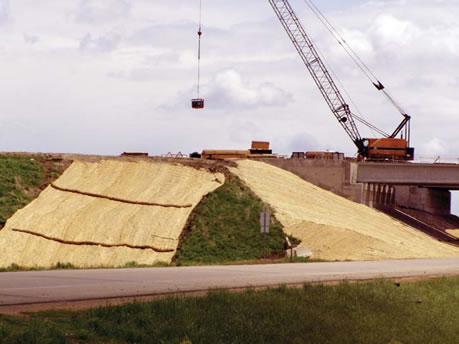
Prepare the Slope for Full Contact
A blanket only performs as well as the surface beneath it. Getting the slope ready creates the contact and control needed for the system to hold when water starts moving.
- The slope should be shaped and smoothed so the blanket sits tight to the soil without floating, bridging, or leaving gaps that invite runoff underneath.
- All tilling, fertilizing, and seeding should be completed before installation so the blanket remains undisturbed once it is anchored.
Clods, debris, and sharp material must be removed to prevent lifting, tearing, or loss of contact when flow increases.
Lock the System at the Slope Crest
The top of the slope determines whether water stays on the surface or gets underneath the system. A properly built anchor keeps the blanket working with gravity instead of fighting it.
- Installation should always begin at the slope crest so runoff cannot undermine the system from above.
- An anchor trench measuring six inches deep by six inches wide should be excavated across the top of the slope to create a mechanical lock point.
- At least twelve inches of blanket should extend into the trench and be stapled firmly along the bottom at approximately twelve inch spacing.
- The trench should be backfilled and compacted, then the excess blanket folded back over the top and stapled again to seal the anchor in place.
Roll and Secure the Blanket Downslope
Once the leading edge is locked in, the blanket can be placed so water flows over it, not beneath it. Consistent alignment and anchoring keep the system stable under runoff.
- The blanket should be unrolled straight down the slope, aligned parallel to the direction of water flow to reduce uplift and displacement.
- Continuous contact with the soil surface should be maintained to prevent water pressure from building beneath the blanket.
- Anchoring should follow the appropriate Ero-Guard staple pattern based on product type and site conditions to keep the blanket secured as flow increases.
Build Overlaps That Resist Flow
Overlaps are the first place water will test an installation. Proper alignment and fastening turn seams into reinforced connections instead of failure points.
- Adjacent blanket edges should overlap a minimum of six inches to block water intrusion along the seam.
- Consecutive blankets down the slope should be installed in a shingle pattern, with the upslope blanket always overlapping the downslope section.
- Overlapped areas should be fastened together with staples spaced twelve inches apart so both layers act as a single reinforced system.
When installation follows this sequence, Ero-Guard erosion control blankets stay in place, resist displacement, and support vegetation through storm cycles, seasonal shifts, and extended establishment periods.
As part of Nexterra’s platform, Ero-Guard pairs consistent manufacturing with practical field guidance, helping crews install with confidence and leave slopes stable long after construction wraps up.